hushed.life

sensitive spaces for sensitive people

  • Small Space Living

    Given the population ever-increasing on our small island here in the UK (and the planet, don’t get me started…), I am always interested in how we can take up less space. And, I confess, I’ve always been a tad obsessed with clever furniture and how people design their small spaces into homes. P and I even bought one of these…

    …I adored it! It’s a tiny Freedom Classic caravan we nicknamed LoveBug. I used it on the drive as an office to write in and we towed it with our tiny car to stay in various places. Sadly, I was still very sensitive then and didn’t realise I was reacting to the water system plastic so I was ill every single time we went out with her. Regrettably, we had to get rid, but we sold her back to the man we bought it from for the same money as they hold their value really well.

    They are the only vans, I think, that are made from one piece of material so they don’t rust or let water in etc as others do. I’d like another one, in fact, but P was never keen on towing it and I was useless at it. It was the reversing that worried us down tiny roads in Cornwall! We fitted a turny-roundy thing (menopause brain strikes again, Googles: ‘thing you fit to turn caravans round with’…). motor mover! But it didn’t stop the anxiety. Shame.

    Anyway, here are some pretty inside pictures for you to drool at if this is your thing too. It’s not where we bought ours from – a second hand one on Preloved, I recall for about £5k – but this is a good site to explore them.

    I just had a quick look on Preloved. Loads of people wanting one, none for sale. Shows how popular they are. And relatively unknown!

    Anyway, I digress. Back to living in small spaces.

    I spent a happy 15 mins yesterday watching the video below where the woman has built customised furniture to fit her 333sqft flat. Just SO clever. Tons of storage, a hall, wardrobes, extendable dining table and a Murphy pull down bed. P made me one of these when we were in Plaidy, Cornwall; desk by day, guest bed by night. You can just about see it here in the pictures from when we sold it which I just found on Zoopla!

    I used some Laura Ashley fabric stuck to a large panel and the white desk with two Ikea cabinets at the sides. The mattress lived behind the panel. Then, to use it as a bed, we moved the desk across to become a dressing table and pulled the bed down, the base resting on some cut down Ikea bed legs we kept on top of the mattress behind the panel. MUCH cheaper than a Murphy bed and just as effective, maybe not as pretty as in the video below. But it worked for us in a small bedroom. Don’t worry too much about me being squeezed in there writing to you for over 4 years. I had a garden office built to get some peace! It was luuverly…remind me why we sold this house again?

    I planned to do my non toxic facials and massages again one day (hence the towels etc on the shelf), but I couldn’t tolerate the oils yet, sadly. I used it as a guest bedroom, clinic office and writing space instead.

    Oops, I digressed again. Here’s the video – bit of an advert for some design software in the middle but some good ideas and inspiration.

    Our current rental flat is just about double that size and, both working from home, it feels a bit of a squeeze. But it has fabulous sea views so we are loving it for that. It gives me ideas for small space living and hope that we can keep the sea view and squeeze into something that we can afford now the prices in Cornwall are so horrendous!

    Here is the balcony we have with such a wonderful view. I think the balcony is half the size of the whole flat – great for Summer, going to be a bit of a squeeze in Winter. Anyway, I shall enjoy it while I can.. I’m surprised P and I haven’t killed each other yet, to be honest…

    first published on my Purehealth blog

  • Choose Non Toxic Air Fryers

    Air fryers are all the rage, aren’t they, not least because they save us the cost of putting the big oven on for smaller meals? They can also cook much faster (partly because they are smaller and take less time to warm up) and we tend to use less fat to cook with. Some of them look great on the countertop, too. I think of them as mini fan ovens, really.

    But, I haven’t bought one yet.

    Why? Well, partly because my current rental kitchen is teeny-tiny, but more because most of the nicer-looking ones are Teflon or non-stick lined and I try to avoid that. They’re fine to start with, but once the lining gets a few scratches, they can leach so-called ‘forever chemicals’ into your food. No thanks.

    Truth be told, Teflon is a lot less toxic than it used to be:

    “There has been some concern about whether air fryers can release toxic chemicals when heated. While it’s true that some air fryers may produce harmful compounds when heated to high temperatures, it’s important to note that not all air fryers are created equal.

    “Some air fryers are made with materials that are more likely to release harmful chemicals when heated, while others are made with safer materials such as stainless steel or ceramic. Additionally, the type of food being cooked and the temperature at which it’s cooked can also affect the formation of harmful compounds.” says Jim.

    “Research on the safety of air fryers is ongoing, and while there have been some studies that have raised concerns about the potential health risks associated with the use of air fryers, the overall consensus is that air fryers are generally safe to use.”

    Tech Radar

    I note there that most should be OK, but it would seem sensible to me that us sensitive peeps make sure that any air fryer we buy comes from a reputable source or brand, and that it be made, preferably, from stainless steel, glass or ceramic.

    So, of course, I went on a hunt for some for us.

    I found a small ceramic one here, which I thought was quite cute for the kitchen.

    A 20 litre size stainless steel one from Russel Hobbs here.

    Or, how about a rather space-agey glass halogen one?

    There are others available, of course, but I thought those might start you off. As always, remember to ‘off gas’ them. Heat them up and let them air in a different, well-ventilated room or outside until the ‘new’ smell dissipates.

    Do share how you get on and any air frying tips as I’ve not tried it yet. Enjoy x

  • Is our sensitivity a brain issue?

    Quick Summary: when we are highly-sensitive, especially if we have multiple sensitivity (food, chemicals, smells etc), overwhelm, mental and physical fatigue, a need to shut down a lot, maybe we should consider that brain processes and neuroinflammation, like a loss of brain-gating or neurons too close to threshold could be contributing ie. our sensitivity levels could be brain-based.

    Zoning or Checking Out

    One of the ways my sensitivity shows itself is that I get overwhelmed easily in busy places. Imagine you are in a shopping centre, or a cinema, or simply a family get-together. Do you sometimes need to go out into the garden, or pop to the loo when you don’t need to go, just to get away for a bit and re-set yourself? I do. Do you often need to have a lie-down even when you’ve just had a pretty normal day; you feel exhausted and shutting down, even for 10 minutes seems to help you? You’re not napping, you’re closing your eyes and ears, getting a little warmth and comfort, a little bit of peace. Yes?

    That’s a sign of the highly-sensitive person taking in too much sensory information; of an input overload, if you like.

    Why does over-stimulation happen?

    Some experts might see this as a brain fatigue type problem rather than a personality type issue, actually. There is a process in the brain called brain-gating. Let me explain…

    Brain-gating

    Almost all sensory stimuli goes through the thalamus in the brain and lots of inhibitory mechanisms (too complex to go into here) are needed to stop the thalamus activating in response to them. This is called thalamic-gauging or brain-gating. I heard one expression that 10% of the brain does things and the other 90% is there to stop it and keep it under control! The brain-gating mechanism is a good example of that.

    If we didn’t have something to stop the thalamus processing and acting on all the sensory information coming in, we would get overloaded and not be able to cope. Just imagine being in a crowded room with lots of sounds, smells, people, chatter, music, tastes from the buffet etc – we have to have brain-gating to filter out what is not so important at any given time.

    Essentially, the thalamus is responsible for inhibiting the sympathetic response, so if a person has lost some gating, they are more likely to be sympathetic dominant (possibly even classed as having some form or degree of dysautonomia), which means they become over-reactive to stress and stimuli.

    Symptoms might include hypersensitivity to food, smells, sound, light, stress, movement and gravity, often they have fleeting pains in the body that move about all over the place, anxiety, adrenaline rushes, their heart races, they can’t get to sleep and more besides. The body is basically ‘listening’ too hard and reacting to too much as it comes in. The level of brain-gating loss will determine how hypersensitive a person is.

    Neurons too close to threshold

    This is a another, different brain process, which has a similar effect.

    Neurons (brain cells) communicate with each other by discharging small messenger chemicals called neurotransmitters, such as serotonin and dopamine. The neuron/brain cell has a sort of threshold where it won’t react to a messenger until there is enough of it ie. there is an amount of input needed to make it fire – and this is called ‘the threshold’.

    If a neuron is far from threshold, a great deal of input is required to make it fire. One example would be someone who needs to turn the volume ever-higher on their iPod in order to hear music.

    On the other hand, when a neuron is close to threshold it fires too easily and will react to any old sensory input when it shouldn’t. Do you see?

    When too many neurons are close to threshold, any type of stimulation causes fatigue, especially overload type fatigue – it’s like our brains have had enough, thank you. Driving your car, reading a book, having a conversation, or other normally easy tasks become a huge burden. Unfortunately, many people’s neurons are unhealthy and become either too far from or too close to threshold.

    Summary of brain fatigue/overload/neuroinflammation signs and symptoms

    Any or all of these might indicate an issue:

    can’t handle too much light or sound, blinking lights, can’t bear things touching skin or the feel of food in the mouth, react to smells, can’t tolerate foods/supplements/chemicals. No brain endurance, have to absent yourself or avoid things, shut eyes, move away, sleep – shut out or reduce the stimulus in some way. Can’t read for as long, drive as far as we used to, concentrate, focus, bring words and thoughts together.  Can’t handle crowded rooms, lots of different noises or conversations going on. We need lots more sleep and/or ‘alone’ or down time than we did.

    The symptoms depend where the inflammation is taking place in the brain; it could be localised or a general loss of ATP – the energy ‘currency’ in the cells, if you like.

    Sounds like me – does it sound like you? Fascinating stuff, anyway.

    I’ll do a follow-up post shortly on more of this, especially what might cause it and what we might be able to do about it, I promise.

    Meantime, let me know what you think; do you recognise yourself?

  • Add a little candlelight

    I’m seeing a lot of recommendations for Autumn/Fall candles at the moment. It’s just a shame most of them would set us off with paraffin wicks and bases, and synthetic fragrance oils that, frankly, make me feel queasy.

    You can buy non-toxic candles, of course, but it is much easier and cheaper to make your own – which also means you can control what you are breathing in, too.

    I tend to buy plain soya candles – I find beeswax smells too strong – and add my own essential oils. It’s pretty simple. Just light your new tealight or candle and wait until there is a small pool of wax. Then, blow it out and add a few drops of your favourite oils. Let it harden again and the next time you light it, it will smell divine – FAR nicer than any shop-bought one you could get, and for a lot less cost!

    So, which oils could you use? Depends on what you want to achieve, but a good Autumn/Fall mix would be deep spicy cinnamon, the foresty scent of cedarwood, and a dash of orange or mandarin for cheerfulness. Or you could buy a blend like this Warming Spice one from Napiers.

    When your candle runs out of fragrance, add a couple more drops of your oil just after you blow it out, and next time you light it: good as new.

    If candles aren’t your thing, why not do as our grannies did and bundle up some fresh cinnamon sticks with some allspice, and stud an orange with cloves? Delicious scents, right there.

    Or, you could forage some wooden branches and greenery from your local area and pop that in a vase.

    I can smell it now, can’t you? Enjoy, and happy Autumn x

  • Are you a house husher?

    Do we underestimate how much our environment and surroundings affect our health and mood?

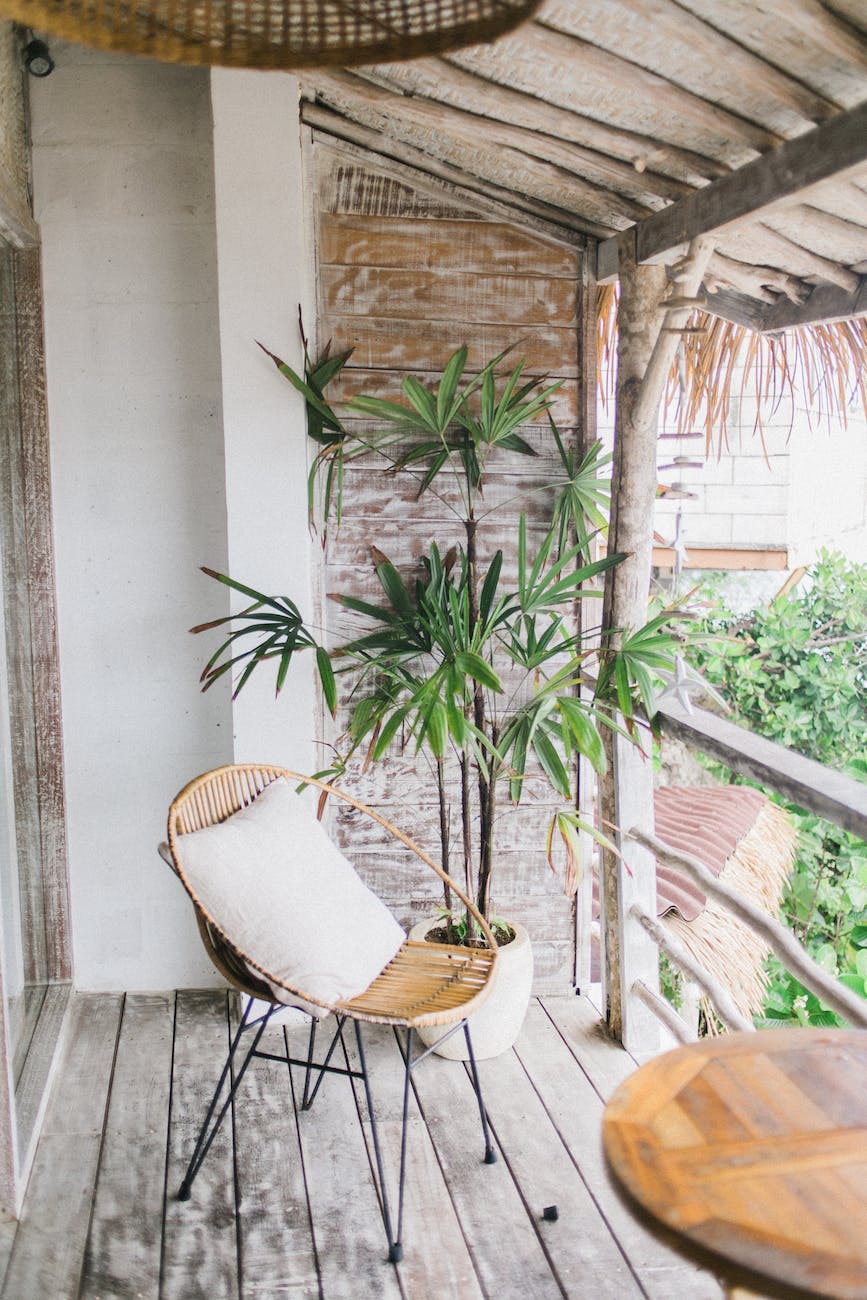
    Which makes you feel calmer? This…

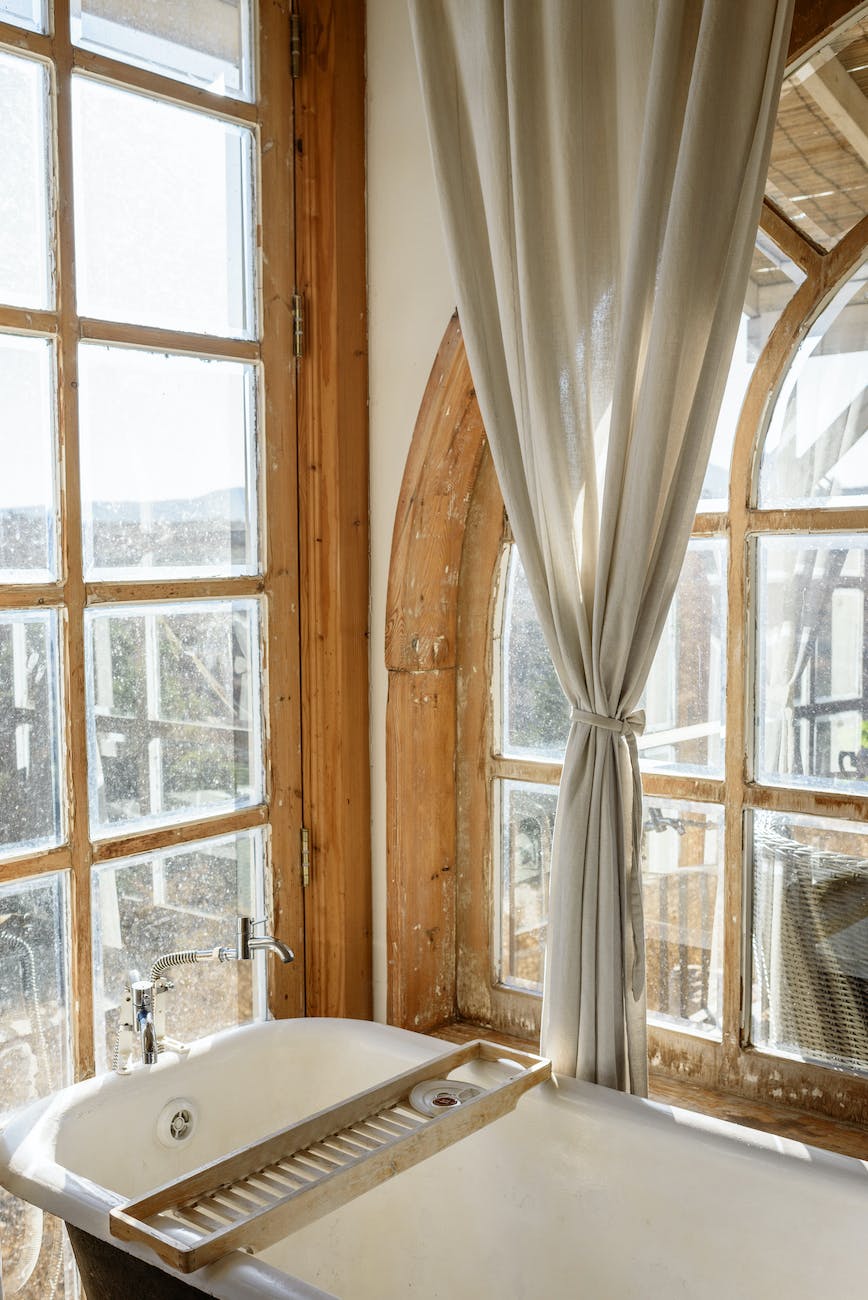
    or this….?

    Both are lovely, but one makes me feel more relaxed than the other. The top ones. The others are just too busy for me, but you may love them! It’s all subjective, but us sensitive peeps tend to prefer simpler and with more space around us, am I right?

    I recently stayed at a friend’s house for a week. She’s a maximalist and loves nothing more than colour and ornaments everywhere. They all mean something to her and they give her joy. I like some colour and a few bits and bobs, myself but I couldn’t believe how much it affected me. Since I am hypersensitive in most ways in life, ‘visual’ and real noise really hurt me. I felt like my nerves were jangled and I couldn’t rest my eyes. I felt headachy and stressed the whole time I was there!

    Happily, she had a fantastic picture window onto an incredibly calming sea view so I stared into the distance at that to quieten the overwhelm! Love her to bits, but I was glad to get back to my own ‘controlled’ space, you know. Shows how different environments affect people differently, though, doesn’t it?

    So, I was interested to read an article in The Guardian recently and discover that I am a natural ‘house husher’; I deliberately make my home and surroundings peaceful and calm; it feeds my need for harmony and quiet. I tend to like homes that have a similar colour running through them, different shades maybe but ‘tonal’, as they call it in interior design. I might have a pop of bright colour here and there, which makes me smile and, in fact, helps neurologically with brain retraining away from negative feelings to positive. More than that is just too much; I like my eyes to be able to rest.

    What is House Hushing?

    It’s all about eliminating visual “noise”: anything excessive, jarring, or inharmonious. “Everything in your room has a voice… taking up visual, physical and even emotional space,” according to interiors blogger Myquillin Smith of The Nester. “Quieting your space removes all those voices in a room at once.” According to the hushed-living concept, stuff you accumulate, the flotsam of daily life, but also things you have chosen – ornaments, pictures and decorative bits and pieces – create a hum. You probably aren’t even aware of it – a phenomenon often described, in a perhaps unhelpful mixing of metaphors, as “house blindness”. But the cumulative effect can be a jittery blast, like avant garde free jazz. Fewer possessions, carefully and deliberately selected, can transform cacophony into pure harmony. The Guardian

    I get that jazz reference, don’t you? That jangling feeling of discordance. Ugh.

    You maybe don’t have to have calming colours though; it’s more about nothing being too jarring or out of place. In one of my houses, I had hot pink and lime green in the lounge with a gorgeous turquoise in my office. Gold patterned wallpaper on the hall entrance. It sounds awful, but I let the colours sing and kept everything else minimal; it was a joyful house – three storeys with double-height ceilings, so it could take some colour!

    Do you need to declutter and reduce the visual noise to lower your stress levels? If so, I hope the ideas on this site help. Since I’ve been doing this naturally for years, I thought I’d have a bit fun writing them down and musing a bit on the subject. Let me know x

  • And so to sleep

    What better subject to start my new Hushed blog with than sleep? And headboards to be exact.

    If you’ve ever bought a new headboard, you will probably have found that it stinks of chemicals. The last time I bought one, I had to put it in the communal hall of our apartments to let it off-gas for a couple of weeks. Much to the other residents’ consternation, and mine. Not good. But there was no way I could have slept in the bedroom with that pong. I’d have had permanent migraines.

    Off-gassing, by the way, is simply letting a thing air so it releases a lot of the chemicals and smells. I have had to do that my whole life. I’ll do a whole post on off-gassing at some point, but here’s a quick explanation: off-gassing (or out-gassing, you can use either term) is allowing VOCs (volatile organic compounds) to release into the air. You can tell if a product contains VOCs by the smell. Think of low odour paint, which has fewer VOCs and smells less, or the smell of a new plastic toy, or even a magazine. In other words: if it pongs, it is probably releasing VOCs. They’re harmful to health, so none of us should be breathing them in really, but for us sensitives, they can cause even more problems.

    Anyway: how can we avoid having to off-gas our headboard?

    Returned headboards

    One way might be to buy a headboard that has been opened, unused and returned to the manufacturer. I did that once and it worked a dream. It had already done most of its off-gassing. Just call the company of one you like and see if they have any returns; they often do. Or, you could ask them to unwrap it from the plastic packaging and sit it somewhere for a couple of weeks before delivery. I bought mine from John Ryan and they were really helpful.

    DIY headboards

    A different way is to make your own. It sounds complicated, but it really isn’t. I’ve got a real thing about these large wall to wall headboards you see in interiors mags at the moment.

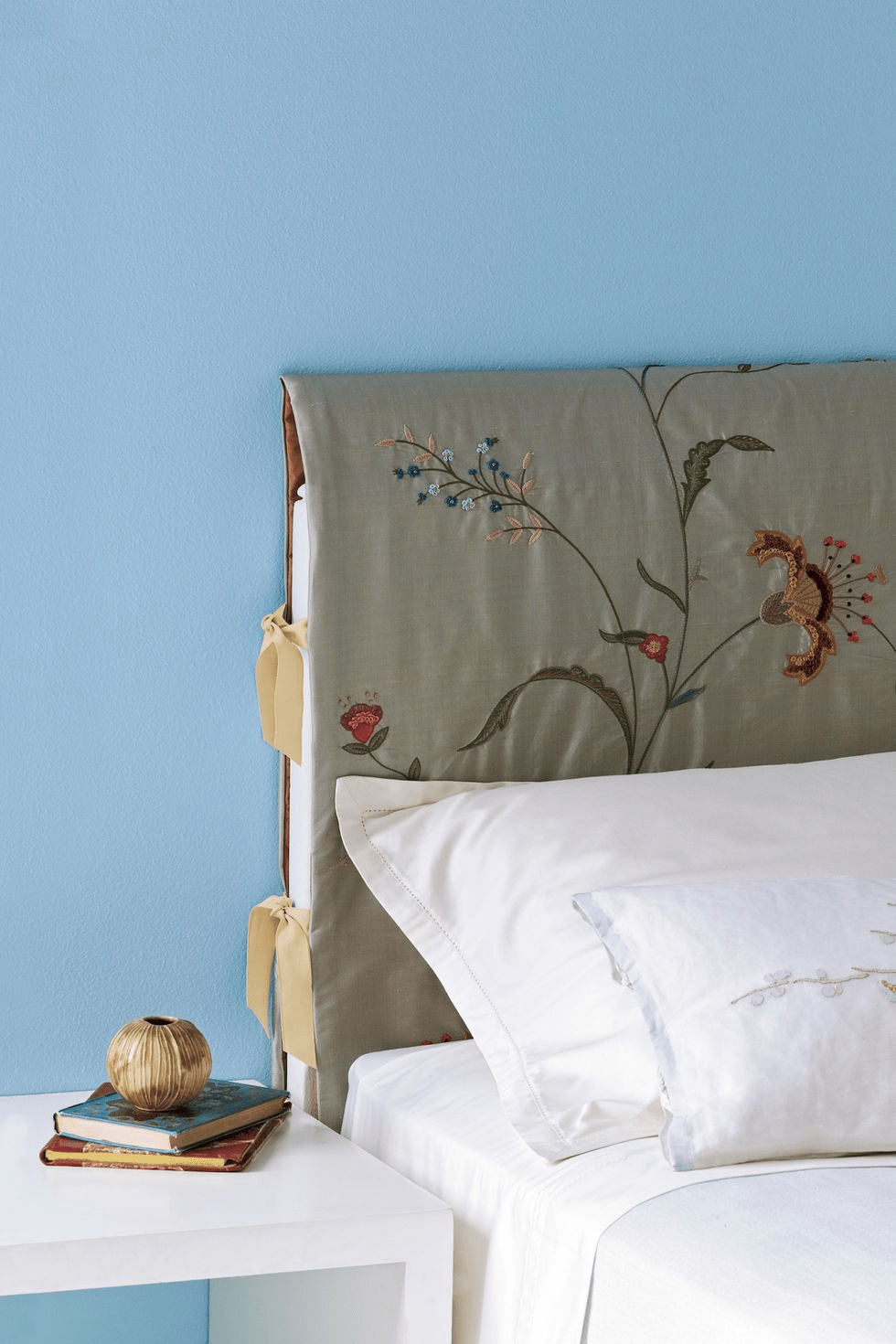
    The Spruce has lots of DIY headboard ideas, including how to make that one above. You could keep it chic and tonal, as above, or just imagine it in a fabulous fabric – a real happy colour pop for your bedroom. You could get someone to make one for you, or use fabric off cuts or off rolls that have been out for ages so less smell.

    Or, how about using a second hand headboard, or updating an existing one with some fabric tied on with ribbons, or maybe drape a throw, blanket, bedspread, quilt or even a rug over it?

    Again, you can choose to keep it tonal or use something to add a pop of ‘happy colour’.

    Beds with headboards

    Or, how about using a bed with a built-in headboard – returns, again? – and adding something beautiful behind it? Ideal Home has some good ideas for headboards here. I once used the wallpaper trick. One roll costs – and smells! – a lot less than a whole bedroom, and it’s very effective. I do like this wall-hanging idea below, too.

    Headboard alternatives

    Maybe not have a headboard at all? I like the look of this massive wedge pillow, which you can get in tonal or bright colours. Or huge superking pillows would work with crisp white or beautiful patterns you can change to match your mood or seasons.

    You might need to off-gas pillows, though, but that is a tad easier than a whole headboard. Just avoid memory foam stuff, which can cause problems for sensitive people.

    So, I hope that’s given you some ideas to freshen up your boudoir – without the toxic chemicals, hopefully. Let me know how you get on x

  • Non toxic, pure skincare

    Much of the toxins we ingest come through what we put on our skin! Many of the so-called ‘natural’ skincare ranges are anything but, sadly.

    I recently came across a new skincare range (to me, anyway) that is simply beautiful, so thought I would share. Hushed is all about living a nourishing life, after all, and that includes establishing nurturing, daily self-care routines that help rather than hinder us.

    If you’re looking for really high quality skincare that nourishes you and the planet, then maybe Inlight Beauty is for you. Happily, you can start with a Discovery samples pack to try before you buy full-size, which I think is a really great idea.

    This is a fabulous brand and certainly not your average skincare products. You can order it here. It is based on real skin science, biochemistry and nature principles. Not cheap, but brilliant quality, they do what they say they will, and wholly organic. A little goes a really long way.

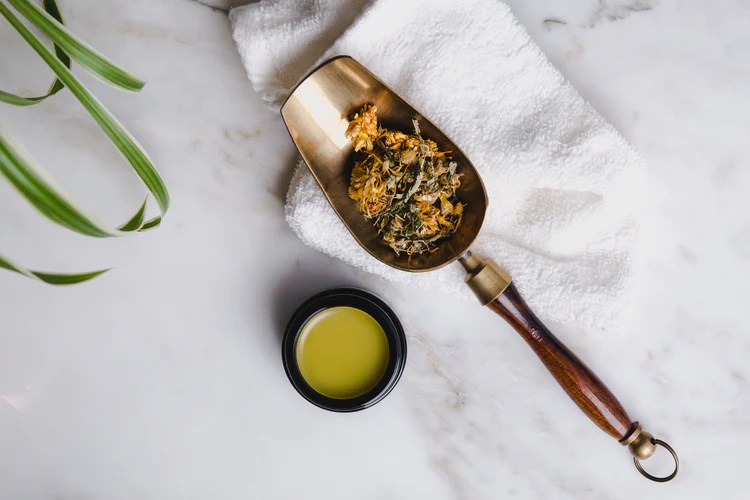
    Dr Spiezia is a doctor, medical herbalist and homeopath and he really cares what goes into his products. They are non-water-based, so you don’t need any preservatives and contain no alcohol. They make small batches by hand in Cornwall, including macerating and distilling their own plant extracts in-house following a biodynamic ethos and they are packaged in violet glass because products simply last longer and have a better vibrational energy.

    They explain:

    “We practise slow beauty, our precious ingredients are expertly mixed and slowly distilled for over a month in cold pressed oils, being exposed to sun and moon light, harnessing their unique subtle strength.

    Once the oils have been fully imbued with care and powerful herbal nutrients, they are cold pressed and filtered to leave a pure and stunningly beautiful oil blend. The final touch is the addition of essential oils or bees wax, nothing else. We work the raw materials as little as possible in order to maintain their natural integrity and vital force.

    Dr Spiezia uses a series of unique techniques during each production stage, such as tuning sounds, alchemic symbols, colours and words of intention, to enhance the vibrational energy and vitality of each ingredient.

    Every Inlight product features Dr Spiezia’s Bio Lipophilic Matrix®- a blend of organic, cold-pressed plant oils carefully nurtured for their high biochemical affinity to the skin. These super concentrated oils are energized using a patented technique where science meets alchemy to heighten the oils’ vital force.

    Hyperspectral study: The efficacy of our unique production process has been scientifically proven to work, leaving a lasting glow to the skin.

    We use MIRON violet glass as primary packaging as this shields the products from UV light protecting quality and vitality of the ingredients for longer.”

    A Hyperspectral Study has confirmed that this unique artisan production method has positive and visible results on our skin, upon application and over time, including:

    • More luminosity & thermal activity: higher biophotons emission from the skin and better blood & lymphatic flow.
    • Lower entropy: optimum self-organisation at a molecular level resulting in a more
      effective and uniform interaction with the skin.

    For those of us sensitive to stuff, including gluten or grains, I asked for more info: “We don’t use alcohols in any stage of the production. The botanicals are infused into the oils for over 4 weeks and then pressed and processed into the final products. Some of our products use barley.” So, watch out for any barley, INCI name: hordeum vulgare. So far I have used the skincare essentials trio, and been fine. Use a tiny amount. Smells heavenly, I promise!

    Check them out here. I’d maybe start with a Discovery Pack, so you can try before you buy full-size products. They are very helpful with samples before you buy, so do always email and ask if you need to.

    Enjoy x